
By Wendy Lee
November 4, 2025
NOTE: Portions of this essay were borrowed from my Dad’s eulogy, which I also wrote.
Dad wanted to ride in my Mustang. Making that happen was the easy part. Helping him in and out of the low-sitting car proved to be more of a challenge. Thankfully, we only had to manage it once that day.
The trip to visit my Dad’s hometown of St. Joseph, Missouri had been a long time in the making—two years, to be exact. It was originally supposed to be a train trip, a nostalgic nod to my Dad’s railroad history. But my schedule had been packed, and the thought of spending three days, each way, confined in a train made the idea feel daunting.
Still, I was frustrated with myself for not making the trip happen sooner. I genuinely wanted to go. What was really holding me back?
I knew the answer, even though I didn’t want to face it: this would be my Dad’s last trip to St. Joe. The truth carried a weight I wasn’t sure I was prepared to bear. But I also knew this trip would give us memories I would forever cherish. I hoped it would mean the same thing for my Dad—a chance to return to the places that shaped him.
By then, Dad wasn’t very mobile, and his mobility would only worsen significantly in his remaining years. He could manage short distances with his cane, but navigating an airport was another test, entirely. I arranged airport assistance, wheelchairs, and all the accommodation I could think of to make the trip easier. But Dad, in true form, stubbornly resisted all of it. Accepting help clearly felt like a blow to his pride. I kept reminding myself how frustrating it must have been for him to feel dependent—on me, or on anyone.
While the logistics of travel were challenging, Dad reveled in the spotlight during our flights. He always had a way of drawing attention. In my teenage years, when Dad traveled constantly for work, he’d return home with stories about flight attendants commenting on his piercing blue eyes. His eyes were a shade of ice blue that was impossible not to notice.
On one leg of our trip, we were upgraded to First Class. Like my Dad in his working years, I traveled frequently for my job, and upgrades had become a perk of the routine. From San Francisco to Kansas City, we sat in the First-Class bulkhead while the flight attendant doted on Dad. She, too, commented on his eyes, giving him more attention than anyone else in the cabin. She paused to listen as Dad proudly explained where we were headed.
“I’m going home to St. Joe. My daughter, here, is taking me,” he said, beaming.
In that moment, I knew. Despite his protests, his pride, and his frustrations, Dad was grateful. So was I.
We had come a long way, Dad and I, both literally and figuratively. As a child, I never imagined a time when we would be close.
A quick exchange between my best friend and me when I was maybe ten or eleven years old still sticks with me today. Dad was on one of his many trips when my friend said innocently, “You must miss him a lot.” I don’t remember my reply, but I am sure I fibbed and agreed that I missed him. The truth was, I didn’t.
When Dad was home, there was often anger. While he would do grand—or semi-grand—gestures, like building me a balance beam in our front yard, mostly he seemed distant, disinterested. He rarely had time for me, and when he did, his temper often loomed larger than his presence.
Only later in life would I come to understand him better—the immense pressures he was under with work and money, the challenges with my brother, staying involved in the community when his time was stretched so thin, and taking care of his extended family. He carried these burdens without the emotional tools to process them or share them.
Those times were in the rearview mirror, as they say.
Sitting beside him on the plane, I realized how rare and lovely it was to recognize “a moment” as it was happening. Watching the miles pass beneath us as we neared Kansas City, I knew this trip would hold significance for both of us. It was a time to be mindful, to soak in every small detail, I could feel it already—how meaningful the next few days would be, for Dad and for me.
Playing tourist with Dad turned out to be more fun than I expected. I’d been to St. Joe plenty of times as a child and at least once as an adult, always to visit my aunts, uncles and cousins. But I had no real memory of seeing the town itself.
One of our stops was at the Pony Express Museum. While I was vaguely familiar with the Pony Express, the details were forgotten. I learned that the Pony Express started in St. Joseph and terminated in Sacramento, California, and that you could get a letter to San Francisco in ten days.
I love these kinds of museums, the ones that help you know a little history without overwhelming you. I soaked up as much as I could, knowing full well I wouldn’t remember all the specifics later. But in that moment, I was completely engrossed.
Dad, however, moved through the museum at his own pace. He walked slowly, often pausing to sit and catch his breath. I wandered ahead, reading plaques and displays, but I’d always circle back to check on him.
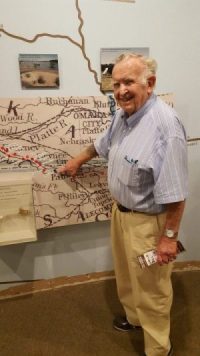
At one point, I noticed him lingering by a map. He was studying it closely, his eyes twinkling with mischief as he caught my gaze. Then he pointed to a small town on the big Pony Express map and said, “That’s where I spent the night in jail.”
I blinked. “What?”
Dad loved to drop unexpected little bombs like that—just enough to hook you before diving into the full story.
This time, the tale went like this: After losing a Nebraska ranch job because his brother Bill quit it for him, Dad had to hitchhike back to St. Joe. As is often the case in Nebraska outside the summer months, it was below freezing and as he became singularly unsuccessful in securing a ride in someone’s warm backseat or even a drafty truck bed, in desperation he asked a local deputy if he would allow him to sleep in the jail for the night, which the merciful lawman allowed. “I don’t think that would happen today,” Dad mused with a grin.
That was Dad in a nutshell, turning what could have been a moment of despair into a story meant to entertain.
We continued to play tourist, exploring the landmarks and memories of his life in St. Joe. Dad pointed out places where he’d worked, another house the family lived in, the park he loved, the downtown street, the cemeteries where so many of our relatives are buried, and the lot where the family home once stood.
That lot wasn’t at all like I had imagined. Instead of barren land or disrepair, it was lush, peaceful and bordered next to a lovely home.
As we wandered through the town, Dad’s stories came alive. He often shared what it was like growing up in St. Joe, the eighth of eleven children. These were his words:
“My name is Richard. I was born in 1933 during the early years of the great depression. I often said I didn’t know what it was like to be poor. My brothers, sisters and I were fed and clothed. Our Mother kept us clean, mended our clothes, doctored us with her home remedies when we were sick and generally kept us safe.
In our home we had no running water. It had to be carried and hauled from a neighbor’s house that was a little more than a city-block away.
At bedtime the couch in the living room made into a double bed. A rollaway bed was rolled into the kitchen. All the kids, as many as nine at any one time, were crowded into the three beds. Mom and dad had a room of their own which also had a crib for the youngest. I learned in my early years what it was like sleeping at the foot of the bed. In the wintertime there was a constant fight for the blankets. Many a times I woke up freezing cold while my older brothers were snuggled warmly under the covers they had pulled off me.”
He went on …
“Several of us were not satisfied with the work that was expected of us. Once in a while, we would complain, but we learned that complaining about anything, especially work, was not tolerated. Most of us found jobs away from home by the time we were in our mid-teens. The money we made was shared equally with the family up to twenty dollars a week take home pay. All we made in excess of twenty dollars was ours.”
That was his youth—a mixture of struggle, resilience, and the deep familial bonds that shaped him.
When Dad returned to St. Joe during his teenage years, in need of employment, he joined the Missouri Air National Guard. The only problem? He was seventeen, too young to enlist. True to the resourceful Van Vacter spirit, he fudged his age on the enlistment papers. It was another “couldn’t happen today” story. When he eventually confessed to his superiors, they allowed him to stay in uniform without punishment, quietly correcting the records.
Dad’s service took him to France instead of the conflict in Korea—a stroke of luck for all of us. That time in France became the backdrop for one of his favorite stories: the time he “skied at the Olympics,” specifically the 1952 Winter Games in Oslo, Norway.
Dad won a ticket to the Games through an Air Force lottery. With no money for travel, his unit took up a collection to help him get to Oslo. That generosity bought him a camera and spending money. While there, Dad met some local girls on skis. Having never skied before, he asked if he could try. One of the girls agreed, and Dad skied a few feet.
From that moment on, his tale about skiing at the Olympics morphed into a story that might make you believe he skied in the Olympics. It was vintage Dad—embellishment for the sake of a good laugh.
After his military service, Dad moved to California, where much of his extended family had relocated. Though he lived far from St. Joe for most of his life, the town and its memories remained deeply rooted in him. He visited whenever he could, always eager to reconnect with his siblings, nieces, nephews, and cousins.
Dad visited St. Joe as often as life would allow. My Aunt Babydoll was the family anchor in St. Joe, but my other aunts and uncles lived in the area, some for a long time while others were more transient. Dad absolutely loved visiting with family, his nieces and nephews, and cousins.
On this trip, we were hosted by my wonderful cousins, who arranged a family gathering at a local church. About twenty-five of us came together. I recently found a photo from that day—Dad sitting at a table, telling stories to my cousins. Their expressions showed genuine interest, and Dad, ever the storyteller, was in his element.
He loved being the center of attention, spinning tales with humor and charm. I lost count of how many times I heard my cousins say, “Uncle Richard was always my favorite.” For all his flaws—and there were many—Dad adored his family. He stepped up when they needed him, always taking action, though often remaining practical and stoic about it.
That trip was unexpectedly healing for me. It deepened my understanding of Dad beyond what I had already come to realize as an adult. Seeing him in his element, sharing his stories, and reconnecting with his roots gave me a fuller picture of the man he was—a man shaped by challenges, guided by duty, and connected to his family in ways that weren’t always spoken but were undeniably felt.
In that moment, sitting at the mini-reunion, I wasn’t just proud of him—I was proud to be like him.
Just a few years later, Dad was gone, his health steadily declining before a sudden heart attack took him. I wasn’t ready to lose him.
I still don’t know how to measure his 85 years of life. But if it’s measured by the love he gave, the lives he touched, and the laughter he shared, then my Dad died a rich man.
Julie said it best: “We always believed there would be another anniversary, another birthday, another Christmas.”

 Personal Searchlight