Perspective in Death Valley
by Wendy Lee
January 25, 2015
This trip has been a triumph. It would not be such for an explorer or adventurer or traveler or pioneer. But for me, it has refreshed my soul.
I now sit in the safe and comfortable confines of my hotel room at the inn. The last room at the inn, literally. It is a holiday weekend. I am trapped for now, which frustrates me tremendously. You have to play with the cards you are dealt, and so far I haven’t figured out how to cheat at this game. Darkness in the desert, even with a moon almost full, provides an insurmountable obstacle for me. I simply can’t see well enough at night to visit unfamiliar places. I could try, but my mind conjures a grim picture of me upside down in my car, tethered by my seatbelt, down a ravine on a deserted desert road. My imagination is dramatic. At least for today, it keeps me safe.
So I sit.
This trip to Death Valley has been effortless, energizing, and grounding. Actually, saying that this journey has been effortless is a small lie. I nearly talked myself out of it as I have a tendency to do. But my soul was aching. It was essential.
With over 3 million acres, Death Valley is the largest national park in the contiguous United States. It provides a meaningful backdrop for which to gain perspective. My life has grown too large and complicated again, my own fault I fully recognize. It is time to make some adjustments, to simplify, to refocus my priorities. The trick is to make adjustments rather than run. I am a master at running.
Death Valley wasn’t my first choice, Bryce Canyon was. It is hard to argue about the magnificence of Bryce, with its red, orange, and white hoodoos formed of frost and weathering. They stand tall, like spires on a castle, guarding the valley floor. The views are impressive and stunning and surprising. The formations are like none I have ever encountered. Hiking into the basin is like climbing into an unexpected and exquisite painting.
I was looking forward to the snow at Bryce, even though I consider myself a desert girl at heart. I gathered my cold weather gear, and purchased a few missing necessities. I was setting out for three nights of wandering Bryce, snowshoeing, writing, reading, studying, soul searching. The weather had other plans. Winter weather warnings calling for one to two feet of snow during my drive there scared me away. Snow on the ground, yes. Driving through a major snowstorm, no.
Plan B. Death Valley.
The Furnace Creek Inn in Death Valley, where I now sit, is only two hours from my home. Two hours. Why have I never been here before? It is inexcusable, but no longer. I have conquered it. Well, perhaps conquer is too strong a word, but at least I have investigated it at the most trivial levels.
I am disappointed in myself for not doing more research before arriving, for I wanted to go a bit off the grid. In reality, staying on the grid is difficult in the confines of such expanse.
For day one of sightseeing, I took both the tourist and wanderer paths. Armed with only the map I picked up at the park pay station and with one destination in mind, Ubehebe Crater, I set off to discover this few hundred-year-old wonder. I paid no attention to distance or time, simply following the sparsely inhabited roads.
The Ubehebe Crater is about sixty miles from Furnace Creek, in the northeast section of the park. On the desolate roads, I passed the Funeral and Grapevine Mountains on the right, Salt Creek, and Mesquite Flat on the left.
I barely looked at the map, resolved to just drive. It took about an hour and a half to reach the crater. I wish it had taken longer. I passed some cars near the various turnoffs, but mostly I enjoyed the solitude of the road, unencumbered by rules. I played my music loud, sang off-key (that’s the only way I know how to sing), and let the thoughts crowding my head escape one by one.
The crater was delightful. Although not remote, there were only about 10 cars in the parking lot and I encountered just one family. The crater is deep, 600 feet deep, formed of a volcanic explosions of magma mixing with an underground spring. An undemanding hike up to Little Hebe Crater reveals not only more of the large crater, but the remnants of several smaller ones. Black and gray volcanic rock gives way to orange and white striated carvings. Purely fascinating.
From the crater, I headed to Scotty’s Castle, ten miles away. The beautiful Spanish style mansion surrounded by trees, unexpected in this remote area, was both intriguing and frustrating. It was surrounded by a large parking lot full of cars and tourists and chatter. Wasn’t I a tourist, too? Yes, but I was looking for a secluded experience this time, one that would allow me to reframe my contorted life. I took a few pictures, got in my car and drove away as quickly as possible. I love history, but Scotty’s Castle was meant for another trip.
I headed back down the hill, back toward Furnace Creek, back to the civilization I was trying so desperately to avoid. It was inevitable. My car was low and fuel and I wanted to see more sights before sundown, my nemesis.
On the way to Badwater Basin, the lowest point in the northern hemisphere, I took the turnoff to Artist’s Drive. The name was irresistible, even though I had no idea what it was. It was excellent marketing. Artist’s Drive is a nine mile drive through a stunningly hued canyon, meandering through narrow rocks of multiple colors. It was a pure visual pleasure.
From there, I drove directly to the tourist enclave of Badwater Basin, 282 feet below sea level. Badwater Basin is truly incredible, for you can view tallest peak in Death Valley to the east, across five miles of salt flats. There were too many people for me, though. I took my obligatory photos and quickly exited to avoid the swarms of humanity.
I started back to Furnace Creek, but stopped to tour the natural bridge. It was just a few miles up a dirt road and then a quick hike in. I love natural bridges and slot canyons. They are exquisite gifts of nature.
The sun was getting low and I needed to refuel myself. I took a quick meal at the vacant cafe, a little too early for the crowds to come in for the night. I finished close to last light, but with enough light to drive the short way to the inn. Although it was getting chilly, I sat on the patio at the inn, ordered a glass of wine, and watched all remains of orange and pink light diminish over the dark Panamint mountain range, the palm trees of development in the foreground.
I was happy with my exploration, even though still done through the eyes of a tourist.
Today was a completely different quest, exactly what I needed. I had time to study the map to determine my general direction for the day. With a full tank of gas I turned my car in the direction of Panamint Springs. Although Father Crawley Vista was my ultimate destination, I vowed to explore whatever I found along the way.
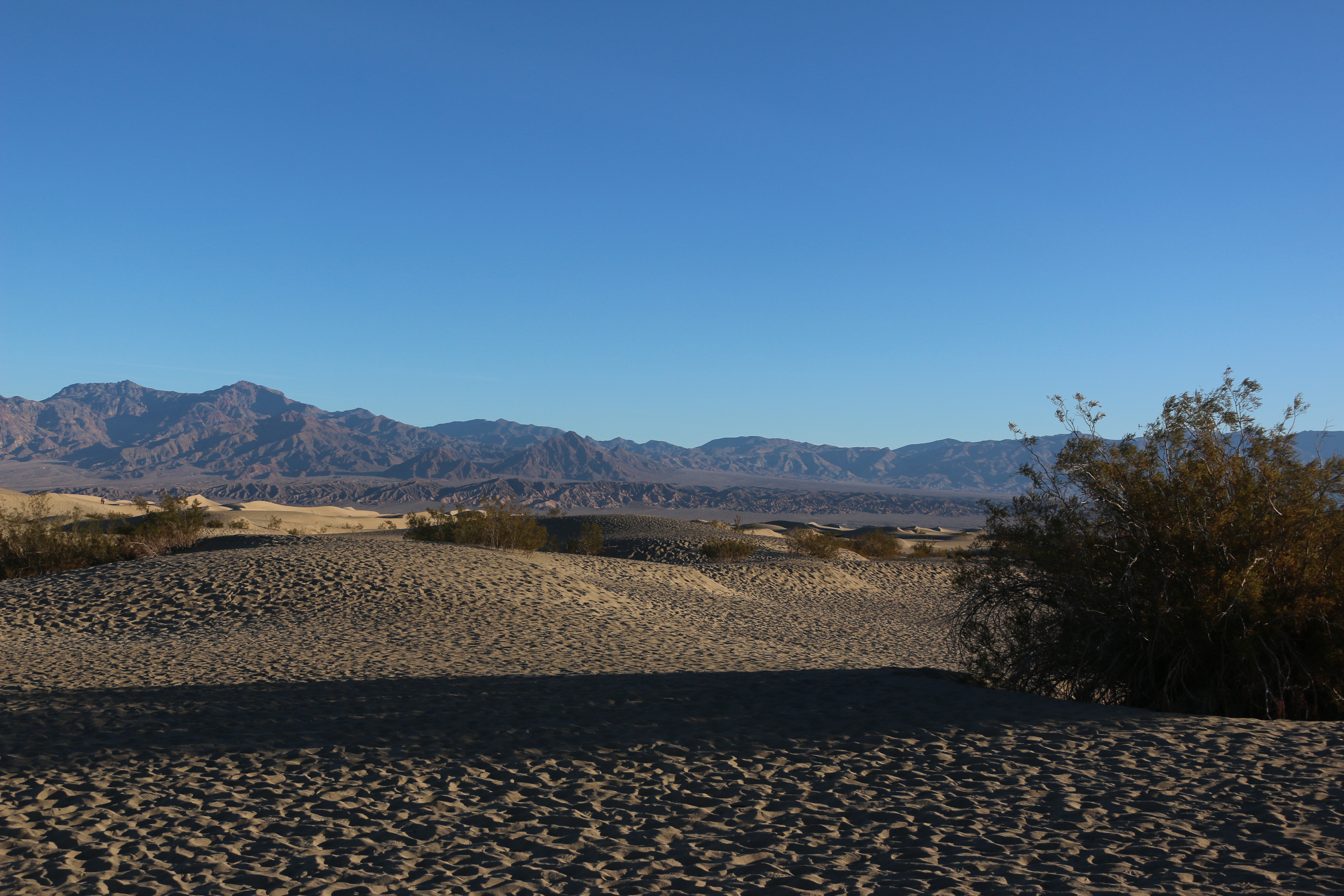
Not far into my trip, just past the turn-off to Ubehebe Crater, I happened upon the Mesquite Dunes. Not off the beaten path, but just after dawn, only a few early risers were out. I took a walk into the dunes, lost in the beautiful yellow-orange horizontal morning light casting black shadows on the soft sand. Sunrise is always spectacular in the desert.
Back on the road, I drove just past Stovepipe Wells and found a dirt road to Mosaic Canyon. How can you not stop off for something sounding so decorative and creative? A few miles up the dirt road, I parked and studied my map. The hike into Mosaic Canyon was only 4 miles round trip. I had the whole day ahead of me, so I grabbed my backpack, some water and my camera and hiked in. It was an easy hike, the kind where you would have to work diligently to get lost. I didn’t. It felt good getting my 10,000 steps in so early in the morning.
The highway to Father Crawley Vista is grand. You quickly enter into rolling hills on a narrow road. The path is paved, but follows the contour of the terrain. With just enough speed, you get the effect of a roller coaster, with the pit of your stomach feeling. More than once, I sped up for maximum benefit, a little thankful my small SUV grabbed the road. I will have to try it sometime in my Mustang. Can I get it airborne?
Towne Pass is only 4,956 feet high, low by the Colorado standard I use to measure all mountain areas. Still, it held a surprise. Coming out of Towne Pass and the Panamint Mountains is a valley so impressive, vast and gorgeous that there are not enough adjectives or expletives to describe it appropriately. Salt flats, layers and layers of mountains, volcanic rock, enormity as far as my poor eyes could see. And except for the tiny stop at Panamint Springs and the thoroughfare dissecting the valley, there was no other evidence of humankind anywhere.
Most of us spend our lives in cities and homes and cars and crowds. We are surrounded by construction and asphalt and concrete and buildings, a sign of a good economy and progress. Yet, it is this barren wilderness of vastness that is calling to my soul. Simplicity, character, perspective, divinity right there in nature. I must pare down my life and obligations, and spend more of my remaining life in the natural world. It is where I feel alive and free and completely comforted. It is beckoning.
I dropped a few thousand feet into the valley, passed right through Panamint Springs and onto Father Crowley Vista. The road was tight and contorted and empty. I passed just one car on the way to the Vista. Although there was a large paved lot with vault toilets waiting at the Vista, there were few cars parked. I noticed a small number of people taking their photos from this spot, but the joy is really in walking the short distance to the overlook. There are dark volcanic rocks evident at the top but the magnificent Rainbow Canyon below, and an impressive view of the northern section of the Panamint Valley. I stood there alone at the overlook, taking my photos, and knowing instinctively that it is not possible to capture all of the layers of beauty in digital form. It is something you must experience with your own senses.
I took in the view for a respectable amount of time and walked back to my car, answering questions along the way. “Is it worth the walk out there?” one gentleman asked. Why would you come this far and not take the time to see it? I was perplexed. I answered politely but passionately that he must see it, it was imperative. Of course, I spent my whole life not only not smelling the roses but not even seeing the roses. I get it. But no more.
I headed back down through Panamint Springs, driving to Stovepipe Wells, but decided to take a little turnoff down the Emigrant Canyon Road toward the Skidoo ghost town site. It was another narrow, vacant, and charming road in a low canyon. I took the Skidoo turnoff, down a rough dirt road. It was completely passable but severely washboarded. The Skidoo town site is nine miles from the Emigrant Canyon Road. After driving about five miles, going just 15 miles per hour at most points, and not encountering a single vehicle, I decided to turn back. I wanted to see what was down that road, but this was my first trip, I was running low on gas, I was solo, there was no phone signal (as is the case in most of the park), and I knew that my family would not approve of this mini-adventure. Another time, maybe.
When I made it back into Stovepipe Wells, I gassed up, purchased a stale sandwich from the market, opened the tailgate of my vehicle, sat, and ate my dry lunch while chatting with the couple who parked next to me. They were more courageous than me, but there were two of them. Could I be more daring too if I wasn’t unaccompanied?
I was happy with my progress for the day but not quite done.
I drove back in the direction of Furnace Creek and pulled off at Salt Creek. There is a quiet picnic area on Salt Creek, with a charming, winding boardwalk. After precious few steps on the boardwalk, all sounds of human life disappeared. No one walked the short distance of the boardwalk except me, so I walked in peaceful solitude in awe of how such a treasure could exist in a place called Death Valley.
There was still daylight left, but not much. I decided to retrace yesterday’s steps and drive through Artist’s Drive again. It was even more captivating the second time through. This time, I stopped at Artist’s Palette to marvel at the pink, yellow, green and purple hues perfectly painted on the mountains by oxidized metal and time.
And with that, my tour came to an end.
The appeal of this park is evident in the contrasts in both terrain and name. You have the Funeral Mountains, Furnace Creek, Badwater Basin, Devil’s Golf Course, Hell’s Gate, Deadman Pass, Coffin Peak and Devil’s Cornfield along with Artist’s Palette, Mosaic Canyon, Striped Butte, Pleasant Canyon, Rainbow Canyon, and Mahogany Flat.
There are both bighorn sheep and desert tortoises.
Badwater Basin is the lowest point in the northern hemisphere but there is also Telescope Peak at just over 11,000 feet. From Telescope Peak, you can see Mount Whitney to the West and Charleston Peak in Nevada to the East. The disparity in elevation provides multiple climate zones and various flora, from desert holly, which tolerates the heat and salt in the valleys, to pinyon pine, juniper, and mahogany in the mountainous areas. You have salt flats, creeks, sand dunes, open desert, volcanic rock, mountains, and canyons.
I reflect here on this simple expedition, something that would come effortlessly to most. Even though you are in the middle of nowhere while in Death Valley, if you stick to the roads and have basic supplies, there is little danger. Unless you are there in the hot months, the worst that can happen to you is inconvenience. Still, it was a success for me to reconnect to nature, gain perspective, to awaken a passion for simplicity, to start thinking about stripping down my life.
I am no adventurer, no survivalist. I explore in the security of national and state parks, on well marked trails. But it is time to break away from this safety net. I don’t possess the skills needed to create my own routes. I am in need of experienced teachers. I hope they appear, and if they don’t, I will seek them out.
I realize, now, that what I am hungry for is not just an uncomplicated life. I need the seclusion and lessons of nature where I am merely an observer. Show me how to take the undeveloped path, and I will be there. Will you educate me?

 Personal Searchlight
Pingback: Life is an Adventure | Personal Searchlight